Not just what Drucker wrote,but how Drucker thought.
Drucker’s judgment, rebuilt as a mental model.A mind made thinkable, not just searchable.
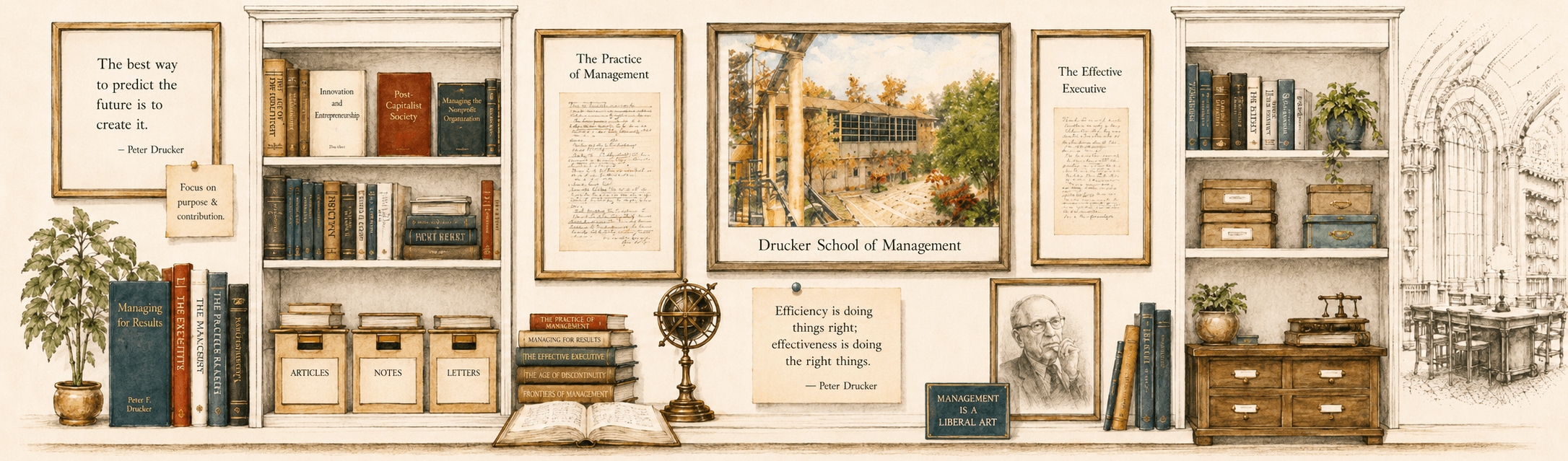
Not a chatbot that quotes Drucker.
A way of thinking.
- The Corpus
His full body of work, from books and essays to letters, interviews, and recordings.
- The Mental Model
The reasoning behind the words, made explicit and reusable, distilled with Drucker experts.
- The Wisdom
A source-grounded way to reason through modern management questions with his judgment.
Knowledge is only the start. The wisdom is in the judgment, in knowing how his thinking applies to what is in front of you.
Two tools, one way of thinking
Think with Drucker
An open conversation to explore a management question and clarify your own thinking.
Best when you’re still working out what you want to say.
Illustrative demo · scripted content

Two tools today, a foundation for many.
Pressure-test a hard call against Drucker’s principles while you’re still in the middle of making it.
Frame the right questions before the meeting — grounded in how he weighed risk, purpose, and people.
Personalized learning paths through his ideas for teams, new managers, and the classroom.
Stress-test structure, roles, and priorities against his frameworks for the effective enterprise.
The model underneath is the product.
“The future requires decisions — now.
It imposes risk — now.
It requires action — now.”
The father of
modern management.
Across seven decades of writing, teaching, and counsel, Peter Drucker gave modern management much of its language and moral center. He named the “knowledge worker,” defined the purpose of a business as “creating a customer,” and argued that every institution, whether corporate, public, or nonprofit, must serve people and society.
Drucker’s wisdom endures because it turns observation into judgment. His ideas, from management by objectives to the effective executive and the theory of the business, are not simply concepts from the past. They remain practical guides for asking better questions, making clearer decisions, and leading responsibly in the present.
Begin a dialogue
Built in collaboration with the Drucker School of Management at Claremont Graduate University. Your work is saved automatically, ready whenever inspiration returns.