DruckerManagementWisdom

Bridging timeless leadership principles with cutting-edge Agentic RAG to deliver an authoritative, knowledge-grounded AI assistant for modern management.

— The Workflow

From a single question
to a Drucker Grounded Perspective.

I

Research

Start with a management question. The research agent searches Drucker’s wisdom alongside relevant current sources, then returns a concise, citation-backed briefing.

II

Ideate

The ideation agent turns that briefing into three distinct writing ideas, each grounded in a core Drucker framework and shaped for a clear point of view.

III

Draft

Choose the direction that fits your purpose. The drafting agent develops it into a polished executive post, ready for your final review.

One conversation. Three guided steps. From inquiry to insight to publication, each stage helps turn a question into a thoughtful piece grounded in Drucker’s wisdom.

— Two Ways In

Start with today's headlines,
or a timeless principle.

FromCurrent Events

Start from this week's headlines.

Start with a live management signal: headline, market shift, earnings call, leadership decision, or industry move. The assistant researches what is happening now, then interprets it through Drucker’s wisdom to produce a grounded, cited perspective.

Example prompt
“Look into what's driving this. Oracle hires new CFO with $26M stock package as thousands lose jobs.”
FromDrucker’s Principles

Go straight to the canon.

Start with Drucker himself. This path is designed for deeper study, reflection, and writing. The assistant works from Drucker’s principles, passages, and frameworks, helping you understand what he actually argued and how it applies today.

Example prompt
“Where does Drucker actually draw the line between management and leadership?”
— The Distinction

Built for grounded thinking,
not generic chat.

I
Anchored, not approximated

Every claim connects back to a traceable source: book, chapter, passage, or unpublished archive record. No unsupported paraphrase. No fabricated authority. The source is always within reach.

II
The whole canon, at once

The assistant works across Drucker’s full body of thought, including core books, essays, lectures, and archival materials. It surfaces patterns and connections that are difficult to see through any single text.

III
Built for long-form judgement

Designed for management research, teaching, reflection, and executive writing, the assistant supports serious work rather than casual chat. It helps users develop grounded perspectives, build personalized learning paths, and move from inquiry to publishable thought.

IV
Defensible by design

Powered by Hybrid RAG with domain-weighted retrieval and citation verification, the system is built for stronger nuance, better source discipline, and more accurate attribution than general-purpose LLMs.

General-purpose AI approximates what Drucker might have said. Drucker Wisdom grounds every answer in what he actually wrote, how his ideas connect, and where to find the source.

Project / Draft
Draft Ready

Prestige Isn’t the Same as Fit

You got the offer everyone wanted. Smart people, huge ambition, a mission that sounds important at dinner. Then a few months in, your work feels strangely heavier than it should. You are still capable. You are still trying hard. But the system seems to reward a different kind of judgment, a different pace, maybe even a different definition of what “good work” is.

That is not always a culture problem. Sometimes it is a strength-system mismatch.

A lot of the Anthropic vs. OpenAI debate gets framed as which company is better. The more useful reading is narrower. Anthropic’s lower reported turnover may reflect a more coherent home for a certain kind of person, not universal superiority. SignalFire’s public-profile analysis estimated two-year retention at 80% for Anthropic versus 67% for OpenAI, but even that comes with measurement limits1. Add in OpenAI’s governance shocks and visible safety tensions, and you have a plausible reason some people would leave even if the company is still full of exceptional talent23.

Drucker saw this long before AI labs existed. He argued that the purpose of an organization is to make people’s strengths productive and their weaknesses irrelevant45. That means a great workplace is not the one with the best brand. It is the one whose mission, structure, and priorities convert what you are unusually good at into results.

“A young man who has the right strength for one organization may be a total misfit in another, which from the outside looks just the same.”6

That line matters because two companies can look identical from LinkedIn and still ask for very different things from you. If one system is built around safety-first research and backs that up in its governance, the fit will feel clearer for people who want that kind of pressure7. If another is pulled harder by product velocity, commercialization, and internal upheaval, the same person may suddenly feel miscast rather than underqualified2.

Drucker’s deeper point is that mission, values, and structure are not soft extras. They shape whether your contribution is even legible inside the organization. Without clarity on mission and strategy, jobs cannot be designed productively; with the wrong structure, work turns into friction and frustration instead of performance8.

So when you look at a “better company,” ask a better question. Not “Would this look good on my resume?” Ask: “Does this system use my specific strengths, or does it need me to become someone else to win here?” That question travels better than prestige.

Source References

1SignalFire, The State of Tech Talent Report — 2025.
2Reuters, From non-profit roots to for-profit ambitions: the OpenAI saga.
3CNBC, OpenAI dissolves Superalignment AI safety team.
4Peter Drucker, The Daily Drucker (2004), “Knowledge Worker as Effective Executive,” p. 552. Passage on making organizational performance compatible with personal achievement and ensuring values fit the organization.
5Peter Drucker, An Introductory View of Management (1977), “Personnel Management,” p. 284. Passage stating the purpose of an organization is to make strengths productive and weaknesses irrelevant.
6Peter Drucker, The Effective Executive (2002), “Staffing from Strength,” p. 90. Passage on how someone can have the right strength for one organization and be a total misfit in another.
7Anthropic, The Long-Term Benefit Trust.
8Peter Drucker, Management: Tasks, Responsibilities, Practices (1986), “The Work of the Manager,” p. 38; and related passage in People and Performance (1977), “New Templates for Today’s Organizations,” p. 174. On structure following strategy and wrong structure producing friction and frustration.
An actual draft generated.
“The future requires decisions — now.
It imposes risk — now.
It requires action — now.”
Peter F. Drucker · Management: Tasks, Responsibilities, Practices (1974)
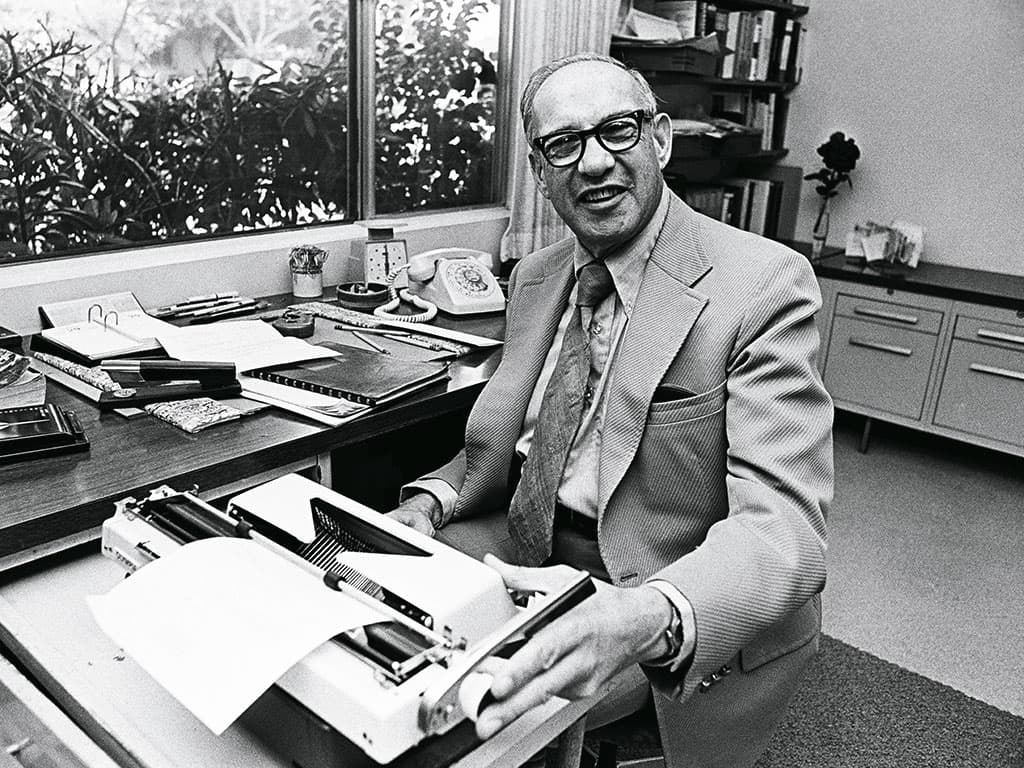
— About Peter Drucker

The father of
modern management.

Across seven decades of writing, teaching, and counsel, Peter Drucker gave modern management much of its language and moral center. He named the “knowledge worker,” defined the purpose of a business as “creating a customer,” and argued that every institution, whether corporate, public, or nonprofit, must serve people and society.

Drucker’s wisdom endures because it turns observation into judgment. His ideas, from management by objectives to the effective executive and the theory of the business, are not simply concepts from the past. They remain practical guides for asking better questions, making clearer decisions, and leading responsibly in the present.

— Signature works
1954
The Practice of Management
Management as a discipline.
1967
The Effective Executive
Effectiveness can be learned.
1973
Management: Tasks, Responsibilities, Practices
The full synthesis.
1985
Innovation and Entrepreneurship
Innovation is systematic, not heroic.
1999
Management Challenges for the 21st Century
A legacy bridged forward.
— When you're ready

Begin a dialogue

Built in collaboration with the Drucker School of Management at Claremont Graduate University. Your work is saved automatically, ready whenever inspiration returns.